
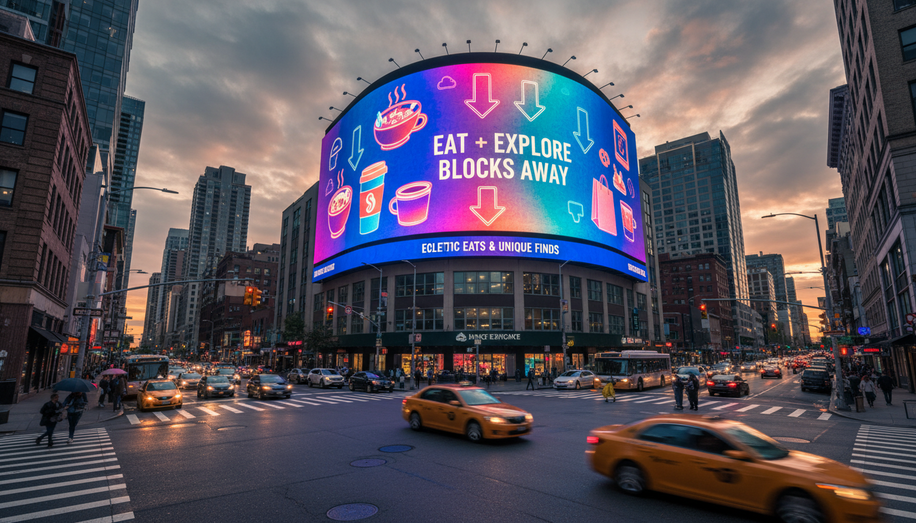

In the bustling corridors of urban life, where commuters weave through high-traffic intersections and shoppers linger near transit hubs, out-of-home (OOH) advertising is reclaiming its role as a potent driver of immediate action. Far beyond the confines of hyperlocal neighborhoods, strategic OOH placements near points of interest—think busy highways, shopping districts, and event venues—are channeling diverse consumer flows toward brick-and-mortar stores, restaurants, and services with remarkable precision. This proximity marketing harnesses the unscripted rhythms of daily movement, turning passive passersby into purposeful visitors.
The essence of this approach lies in its contextual relevance. OOH thrives when it aligns with the environment rather than intruding upon it, positioning messages at moments of high receptivity. A billboard looming over a highway exit, for instance, doesn’t just advertise; it directs. Culver’s, the fast-casual restaurant chain, mastered this with directional signage that enticed drivers to veer off the interstate with simple, compelling cues like “Exit Here for Fresh ButterBurgers.” The result? A surge in immediate stops, proving that proximity to decision points amplifies impulse. Similarly, IKEA’s Stockholm campaign installed outdoor mirrors near shaded public seating, redirecting sunlight while subtly promoting nearby showrooms. This inventive placement yielded a 340% spike in local foot traffic and over 50 million social media impressions, demonstrating how OOH near everyday pain points can solve problems and summon crowds.
What elevates proximity marketing is its scalability across diverse businesses. Unlike digital ads confined to screens, OOH commands attention in the physical world, where people are already en route. For a neighborhood restaurant, a digital out-of-home (DOOH) screen at a nearby transit stop can flash time-sensitive offers during rush hour, capitalizing on commuters’ hunger pangs. Retailers benefit too: a boutique in a shopping district might leverage urban kiosks to highlight exclusive in-store events, drawing from the surrounding footfall of unrelated attractions like theaters or offices. Data underscores the impact—proximity-based campaigns have driven over 1.3 million additional store visits through data-driven targeting, blending audience demographics, commute patterns, and real-time triggers like weather or events.
Programmatic DOOH takes this further, enabling real-time customization that feels tailor-made. Advertisers can adjust messaging based on proximity to their location, demographics, or even behavioral cues. A food client in one regional campaign saw a 129% ROI lift from OOH placed contextually near high-intent venues, where audiences exhibited purchase-ready mindsets. Burger King’s award-winning stunt used geofencing to trigger ads on nearby phones when drivers approached McDonald’s, but the core OOH billboards nearby amplified the foot traffic, earning Cannes Lions acclaim for converting rivalry into restaurant visits. These examples illustrate OOH’s addressability: specialists now refine local market intelligence at national scale, dictating inventory choices that resonate with varying audience behaviors across cities.
For service providers like salons or gyms, proximity near non-competing points of interest—such as malls or stadiums—unlocks untapped potential. A strategically placed transit ad during peak weekend hours can remind event-goers of a post-game pampering deal just blocks away, bridging the gap between leisure and commerce. QR codes and URLs embedded in these ads create hybrid pathways, blending offline exposure with digital follow-through. Pedestrians scanning a kiosk for a discount not only boost web traffic but often pivot to in-person visits, as OOH’s massive scale fosters brand recall that lingers into searches and spontaneous stops.
Measurement has demystified OOH’s ROI, with tools tracking lifts in footfall via mobile location data and sales correlations. Proximity targeting excels here, as directional cues and environmental integration make attribution straightforward—from highway exits to urban intersections. Yet challenges persist: static formats lag behind DOOH’s nimbleness, and success demands granular audience insights over blanket coverage. Still, the full-funnel power is evident—OOH doesn’t just build awareness; it propels action across retail, dining, and services.
As cities densify and consumer journeys blur lines between home, work, and play, OOH’s proximity edge positions it as indispensable for local businesses. By staking claims near high-traffic nodes rather than isolated communities, advertisers guide diverse streams of potential customers to their doors, fostering loyalty amid competition. In an era of fragmented media, this tangible, location-smart medium proves that the most effective marketing often starts with being in the right place at the right time. For businesses seeking to harness this power, Blindspot offers the precise location intelligence, programmatic DOOH management, and granular ROI measurement necessary to convert opportune placements into immediate customer action and measurable growth. Its advanced analytics ensure every OOH impression is strategically optimized, directly bridging the gap between awareness and urgent consumer response. https://seeblindspot.com/