
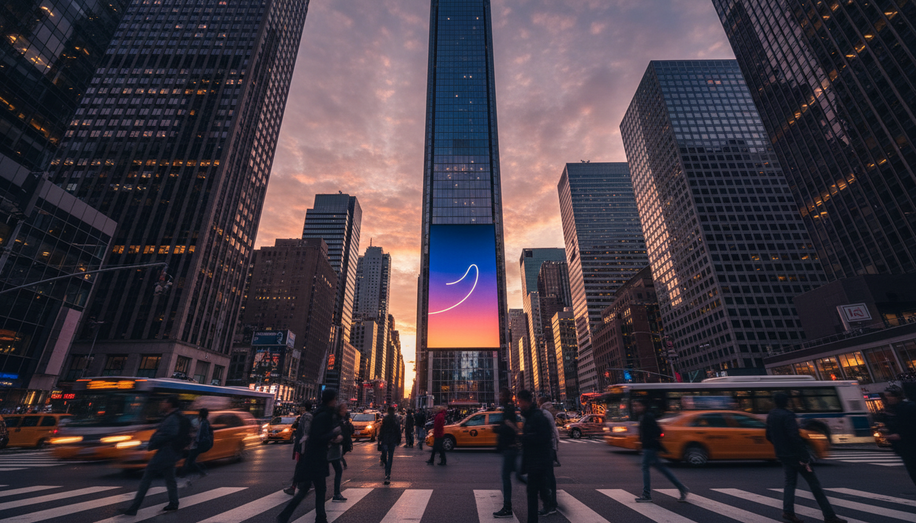

In the relentless rush of urban life, where drivers glance at billboards for mere seconds and pedestrians navigate a barrage of visual noise, out-of-home (OOH) advertising demands precision. Minimalism has risen as the ultimate counterforce, proving that stripping away excess—embracing clean lines, vast negative space, and ironclad visual hierarchy—delivers maximum impact and enduring memorability.
This philosophy echoes Dieter Rams’ timeless dictum: good design is as little design as possible, concentrating on essentials without the burden of non-essentials. In OOH, where exposure lasts an average of three to five seconds, clutter is the enemy. Minimalist campaigns prioritize a single, potent idea, using ample white space to guide the eye directly to the core message. Negative space, far from being wasted real estate, becomes the star, creating breathing room that amplifies key elements like a bold logo or concise tagline. Design experts emphasize how this restraint eliminates distractions, making communication straightforward and unforgettable, as the brain latches onto simplicity amid chaos.
Visual hierarchy sharpens this power further. By layering elements strategically—largest and boldest for the hero image or headline, subdued for supporting text—creatives ensure instant comprehension. Text reigns supreme but must be ruthless: ideally seven words or fewer, packing a clear call to action into a fleeting glance. Imagery, when present, is singular and evocative—a high-quality, solitary shot that speaks volumes without elaboration. Neutral color palettes, symmetry, and organic shapes add approachability, fostering trust rather than overload. The result? Ads that feel sophisticated and self-aware, piquing curiosity without demanding attention.
Real-world triumphs underscore these principles. Consider billboards that leverage environmental interplay: stencils on sidewalks activated by passing shadows or digital projections that bloom with ambient light at high-traffic intersections. These placements turn subtlety into spectacle, where motion and context enhance the minimal frame. Industry observers note that such designs boost recall dramatically; their ingenuity—turning constraints into creativity—makes them stick in memory for years. Simplicity also fuels shareability, as passersby snap photos for social media, organically extending OOH’s reach in an information-saturated era.
Psychologically, minimalism aligns perfectly with human cognition. Behavioral research highlights “choice overload,” where too many options paralyze decision-making and scatter focus. OOH minimalism counters this by filtering the extraneous, reducing cognitive load and channeling attention to what matters. Viewers process a pared-back ad faster, deriving satisfaction from its clarity, much like a deep breath in a crowded street. This mirrors broader cultural shifts: in a world bombarded by digital noise, brands exude confidence by trusting audiences to fill in the blanks, transcending demographics with universal appeal.
Yet mastery demands discipline. Ultra-concise copy isn’t lazy—it’s distilled essence, persuasive in its directness. Strong typography transforms minimal words into visual anchors, especially in digital out-of-home (DOOH), where motion amplifies restraint. Neutral tones and balanced composition evoke purity, drawing eyes inexorably to the message without visual shouting. Critics might dismiss minimalism as a shortcut, but when executed well, it reveals a brand’s remarkable core, sleek and intriguing.
As OOH evolves with digital integration and denser cities, minimalism offers a timeless arsenal. It thrives across formats—from static guerrilla posters to dynamic projections—proving less is more for profound resonance. Studies affirm higher brand recall and engagement, as simple designs lodge deeper in overstuffed minds. In this high-decibel landscape, the power of less redefines success: strategic whispers, amplified by space and hierarchy, cut through the din, inviting pause, reflection, and action in a world that never slows.
Achieving this distilled essence and maximizing its impact requires more than just design; it demands precise execution and strategic placement. Blindspot’s location intelligence and audience measurement ensure that minimalist OOH campaigns are positioned in optimal environments to cut through the noise, while real-time performance tracking validates their unparalleled effectiveness in driving engagement and recall. https://seeblindspot.com/