
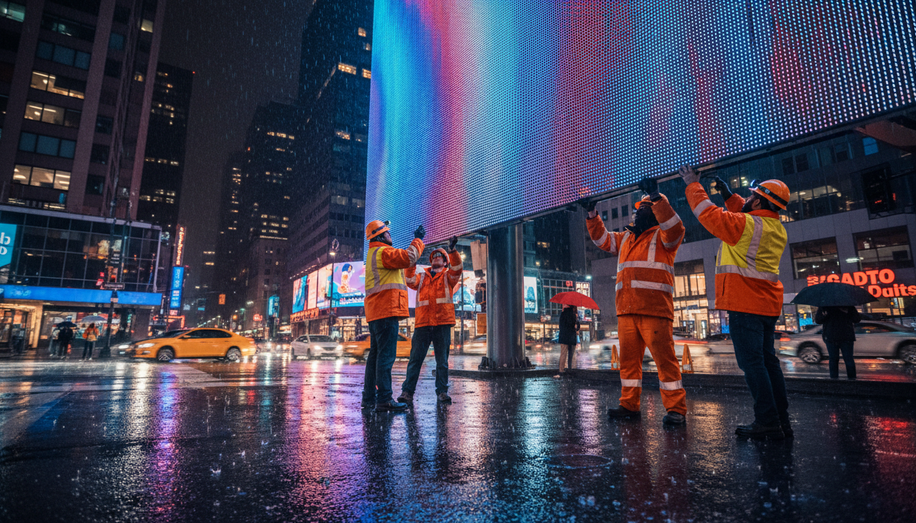

In the predawn haze of a Manhattan morning, a crane hums to life, its steel arm slicing through the crisp air as it hoists a 50-foot LED panel skyward. This isn’t a movie set—it’s the gritty reality of installing a massive out-of-home (OOH) billboard in Times Square, where Groove Jones recently orchestrated a spectacle for Spirit Halloween. The project demanded precision engineering to create an anamorphic 3D effect that makes a towering skeleton appear to leap from the facade, claws outstretched toward passersby. What begins as a digital render in a design studio culminates in this high-stakes ballet of logistics, where a single miscalculation could topple millions in media value.
OOH installation has evolved from slapping posters on plywood to a symphony of multidisciplinary expertise. At the heart are structural engineers who pore over blueprints, ensuring the framework withstands wind gusts up to 100 mph and seismic shifts in urban hotspots. For Groove Jones’ campaign, teams collaborated with architects to fabricate custom trusses from lightweight aluminum alloys, each segment prefabricated in a Texas warehouse before trucking cross-country. “It’s like building a skyscraper horizontally,” says project lead Marco Vega. “We model every bolt in CAD software, simulating pedestrian sightlines to nail the forced-perspective illusion.” On-site, riggers in harnesses dangle from skyscraper edges, threading miles of fiber-optic cables through weatherproof conduits—a process that can span 72 sleepless hours.
Craftsmanship shines in the details. Fabricators hand-weld LED modules, calibrating pixel pitch to under 10mm for razor-sharp visuals visible from 500 feet. In one recent Los Angeles install, a beverage brand’s holographic waterfall demanded custom water jets synced to LED bursts, engineered by hydraulic specialists to recycle 1,000 gallons per minute without flooding the street. Painters apply UV-resistant coatings to vinyl wraps, stretched taut over massive frames using industrial heat guns that can melt lesser materials. These aren’t off-the-shelf jobs; they’re bespoke feats, often involving sculptors who carve foam armatures for 3D protrusions, like the undulating waves on a coastal tourism board in Miami.
Logistics form the invisible backbone. Permits alone can take months, navigating city zoning boards, FAA approvals for rooftop installs, and union labor rules. A single campaign might mobilize 50-person crews: crane operators, electricians certified for high-voltage work, and safety inspectors enforcing OSHA protocols down to the millimeter. Transportation is a puzzle—oversized loads require police escorts and route planning around low bridges. Delays from weather or supply chain hiccups, exacerbated by post-pandemic shortages, have pushed teams to innovate with modular designs that snap together like Lego on steroids. “We’ve gone from weeks to days by pre-assembling 80% off-site,” notes Vega, whose team used drones for real-time alignment during the Spirit Halloween build, adjusting panels mid-air for perfect anamorphic distortion.
Behind these feats are unsung heroes: the production coordinators who wrangle budgets ballooning past $2 million, the programmers coding dynamic content that shifts with traffic patterns, and the night-shift installers who vanish before rush hour. Echoes of fine art installations resonate here—think Do Ho Suh’s “Fallen Star,” a tilted cottage perched on a UCSD rooftop, where crews installed faux chimneys with smoke generators and timed lighting to evoke lived-in warmth. OOH shares that ethos, transforming public spaces into immersive theaters. Museums like Remai Modern reveal similar backstage chaos in their documentaries: artists’ quirky demands met with custom rigging, just as OOH teams accommodate client whims like synchronized pyrotechnics for a luxury car launch.
Yet risks loom large. A 2024 Chicago install collapsed under gale-force winds, injuring workers and halting the industry for reviews. Modern campaigns counter with IoT sensors monitoring sway and temperature, feeding data to command centers. Sustainability drives change too—solar-powered LEDs and recyclable composites reduce the carbon footprint of these behemoths, which guzzle 100kW nightly.
The payoff? Memorable impact. Groove Jones’ Spirit Halloween billboard went viral, amassing 10 million impressions in its first week, proving these installations don’t just advertise—they captivate. As OOH evolves toward AR integrations and kinetic sculptures, the artistry of execution endures. It’s a reminder that behind every jaw-dropping street spectacle lies a cadre of engineers, craftspeople, and logisticians turning audacious visions into tangible reality, one precisely placed pixel at a time.