
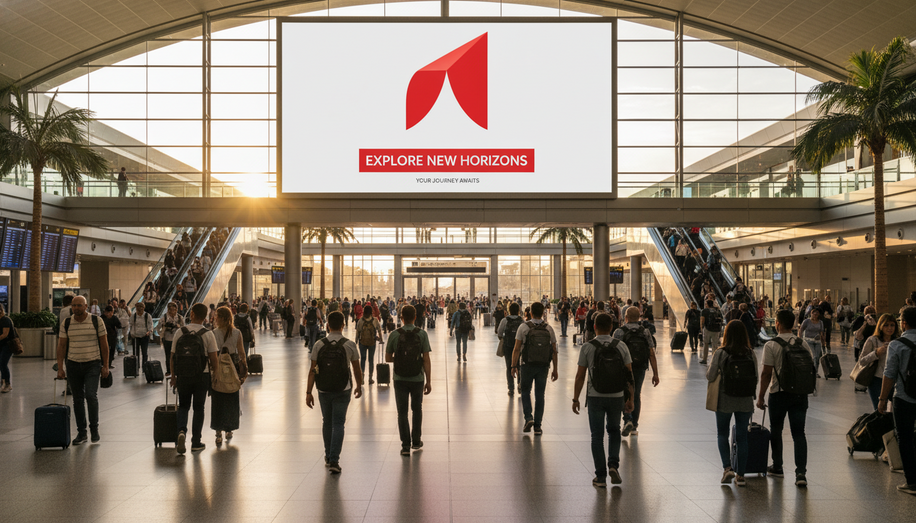

Out-of-home advertising lives and dies in the space of a few seconds. A commuter glances up from their phone at a digital screen. A driver scans a billboard while changing lanes. A shopper clocks a poster as they pass an escalator. In this environment, the art of simplicity is not a creative constraint; it is the creative advantage. Brevity, bold visuals and clear messaging are the tools that turn a fleeting glance into lasting recall and measurable action.
The science backs this up. Studies consistently show that OOH generates some of the highest levels of ad recall of any channel, but only when the creative respects how people actually encounter it: at speed, at distance and often as a secondary focus. The “three-second rule” has become a useful shorthand inside the industry for a reason. If your message cannot be understood in roughly three seconds, it will likely be missed altogether. In practice, this means every element on an OOH canvas must earn its place.
Start with the copy. Long-form storytelling belongs on landing pages and video, not on a 48-sheet. The most effective OOH headlines are typically seven words or fewer, with total copy rarely exceeding 10 words. That brevity forces clarity: one core idea, expressed in simple language, with no subordinate clauses, taglines piled on top of taglines or laundry lists of benefits. The strongest work often reads like a bold, standalone statement: a promise, a provocation or a benefit distilled to its sharpest point. If a viewer needs to reread it, it is already too long.
Font choice is not a mere aesthetic preference; it is a legibility decision. From motorway billboards to street-level screens, copy must be large, bold and instantly readable. Sans-serif faces almost always perform better at distance than serif or decorative type. Avoid thin weights, condensed styles and cursive fonts that disappear the moment you step back. A good test is to view the design at a fraction of its size on a small screen or print-out from several metres away. If the words blur or require effort to decipher, the font is failing the medium.
Visuals do the heavy lifting in OOH, often before the viewer has even registered the words. Strong creative relies on a single dominant image or graphic element that can be understood at a glance. Highly detailed scenes, busy backgrounds and complex compositions may look impressive on a designer’s monitor but quickly collapse into visual noise at scale. High-impact work usually combines one bold subject, a clean backdrop and a palette of saturated, high-contrast colours. Combinations like black and yellow, blue and white or red and white cut through effectively, while notoriously difficult pairings such as red and green can undermine legibility, especially for colour-blind audiences.
This focus on simplicity does not mean creative has to be dull. On the contrary, the most memorable OOH uses its limited toolkit to create moments of surprise, wit or emotional resonance. A single, unexpected image. A headline that flips a familiar phrase. A clever interaction with the physical environment or location. These ideas work precisely because the canvas is uncluttered; the viewer is not fighting through logos, disclaimers and product shots to get to the point. Simplicity creates space for impact.
Context is another crucial layer. OOH is inherently tied to place, and the smartest creative uses that to its advantage. Referencing a local landmark, adapting copy to weather or time of day, or aligning visuals with the immediate surroundings can all deepen relevance. Digital OOH has amplified this potential, allowing dynamic creative that responds in real time while still adhering to the same simplicity rules. A beautifully targeted message that cannot be read in three seconds, however, is still a missed opportunity.
Branding, too, benefits from restraint. The impulse to cram surfaces with contact details, social handles and multiple calls to action is understandable, especially when budgets are under scrutiny. Yet cluttered creative weakens brand impact rather than strengthening it. The most effective executions treat OOH as a brand-building medium first: a clear logo, a recognisable visual style, a consistent tone of voice. A single, simple call to action, such as a QR code or short URL, is often enough to bridge the offline-online gap without overwhelming the viewer.
Testing is where the discipline of simplicity becomes real. Creative that feels powerful in a presentation deck can fall apart when exposed to real-world conditions. Smart teams pressure-test layouts with the three-second rule, mock up placements in realistic environments and view artwork from a distance and at speed. They strip away non-essentials, asking repeatedly: does this element improve comprehension or recall? If not, it goes. This editorial approach to design—cutting, refining, simplifying—turns good ideas into great OOH work.
As OOH evolves, with more digital inventory, richer data and new interactive formats, the temptation will be to add complexity back in. The core principles, however, are unlikely to change. The human eye still works the same way. Attention is still scarce. In a streetscape saturated with messages, the ads that win are those that understand their job: to deliver one clear idea, with bold visuals and concise copy, in the blink of an eye. The art of simplicity is not about doing less; it is about doing only what matters.